Peer-Review Process
Article Review Process
Journal Peer Review Policy
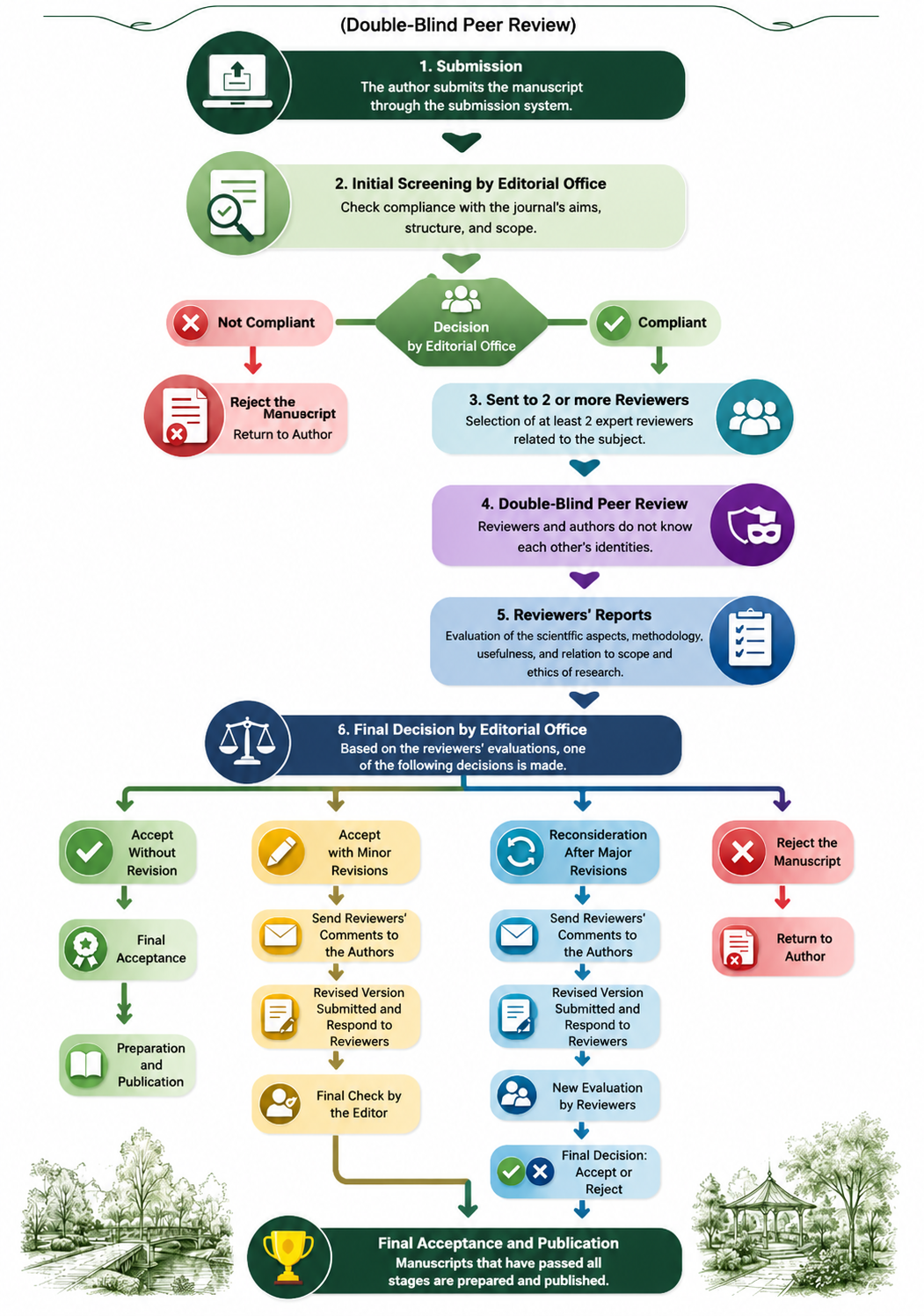
The Scientific Journal of Landscape Architecture and Garden Design employs a Double-Blind Peer Review system to ensure scientific quality, research originality, and fairness in the evaluation of submitted manuscripts. In this process, the identities of authors and reviewers remain confidential to each other, and all manuscripts are evaluated solely based on their scientific merit, originality, methodology, and research quality.
Manuscript Review Stages
- Initial Review by the Journal Office
After receiving a manuscript, the journal editorial office evaluates the following aspects:
- Compatibility of the manuscript topic with the aims and specialized scope of the journal
- Compliance with the journal’s writing guidelines
- Completeness of authors’ information
- Similarity check and plagiarism assessment
- Compliance with research ethics principles
Manuscripts that do not meet the initial requirements will be returned to the authors before entering the peer review process.
- Editor’s Evaluation
The Editor-in-Chief or the assigned Associate Editor evaluates the manuscript regarding:
- Significance of the research topic
- Originality and innovation
- Scientific quality
- Compatibility with the journal’s policies
If the manuscript meets the required criteria, it will be sent for expert peer review.
- Expert Peer Review
Each manuscript is evaluated by at least two expert reviewers.
In cases where reviewers provide conflicting opinions, the manuscript will be sent to a third reviewer for further assessment.
- Final Decision
Based on the reviewers’ comments, one of the following decisions will be made:
- Acceptance without revision
- Acceptance after minor revisions
- Reconsideration after major revisions
- Rejection of the manuscript
The final decision is made by the Editor-in-Chief.
Manuscript Evaluation Criteria
Reviewers evaluate manuscripts based on the following criteria:
- Originality and novelty of the research
- Scientific significance of the research topic
- Relevance to the fields of landscape architecture and garden design
- Strength of the theoretical framework
- Quality of the literature review
- Clarity of research objectives
- Appropriateness of the research methodology
- Validity of data and analyses
- Quality of discussion and conclusions
- Applicability of research findings
- Up-to-dateness of references
- Quality of academic writing
- Quality of tables, maps, images, and diagrams
- Compliance with research ethics principles
Reviewers’ Responsibilities
Reviewers are required to:
- Maintain complete confidentiality of manuscript information.
- Avoid using any information from the manuscript for personal purposes before publication.
- Declare any potential conflict of interest to the Editor-in-Chief.
- Conduct reviews fairly, objectively, scientifically, and without bias.
- Provide comments supported by scientific reasoning.
- Inform the Editor-in-Chief if they identify plagiarism, duplicate publication, fabrication, or manipulation of data.
Authors’ Responsibilities
Authors are required to:
- Submit original manuscripts based on their own research.
- Ensure that the manuscript has not been submitted simultaneously to another journal.
- Properly cite and acknowledge all sources.
- Obtain necessary ethical approvals when using human or animal data.
- Declare any conflicts of interest or sources of financial support.
Confidentiality
All information related to manuscripts, authors, reviewers, and the review process is considered confidential and will only be used for the scientific purposes of the journal.
Conflict of Interest
If any member of the editorial board or any reviewer has a scientific, financial, organizational, or personal relationship with the authors that may affect the impartiality of the review process, they will be excluded from evaluating that manuscript.
Publication Ethics
The journal follows international principles and standards of publication ethics and addresses the following issues in accordance with research ethics guidelines:
- Plagiarism
- Data fabrication and falsification
- Duplicate publication
- Ghost authorship or honorary authorship
- Citation manipulation
- Conflicts of interest
- Research ethics violations
If any violation is confirmed, the journal reserves the right to reject the manuscript, suspend the publication process, retract the article, and report the matter to relevant authorities.
Review Timeline
- Average time for initial review: 7 to 10 days
- Average time for expert peer review: 4 to 8 weeks
- Final acceptance time (if revisions are required): 2 to 4 weeks
General Principles of Peer Review
The journal operates based on the following principles:
- Fairness and impartiality
- Scientific independence of reviewers
- Complete confidentiality
- Transparency of the review process
- Scientific accountability
- Respect for the rights of authors and reviewers
- Improvement of the quality of published research
The primary objective of the peer review process is to enhance the scientific quality of manuscripts and contribute to the advancement of knowledge in the fields of landscape architecture, garden design, environment, cultural landscape, and sustainable design.